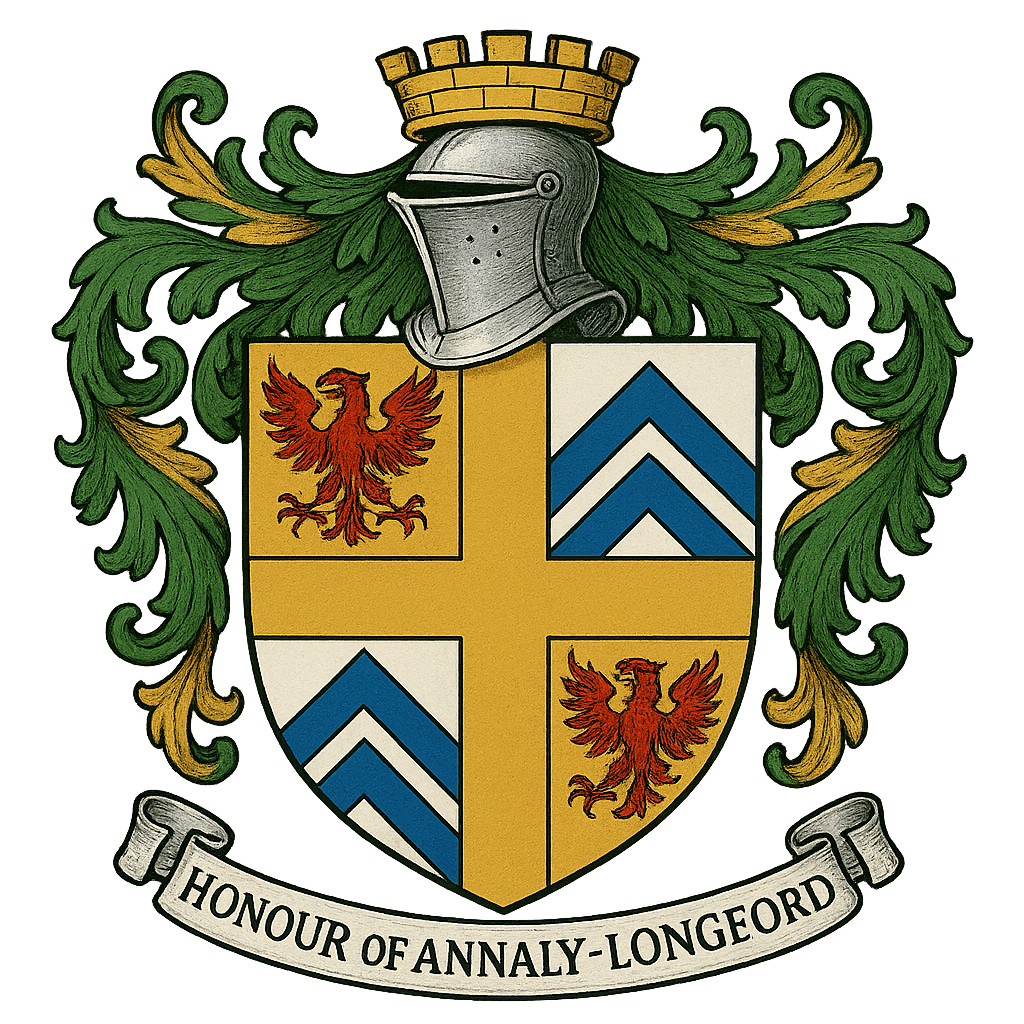
Honour of Annaly - Feudal Principality & Seignory Est. 1172




|

✅ What Legal Rights Still Exist Today for the Honour, Seignory, Barony, Captainship, and Principality of Longford–Annaly?Irish feudal law—like English law—abolished feudal incidents, but never abolished feudal dignities or incorporeal lordships. Thus, the Honour of Longford–Annaly, the Feudal Barony, the Seignory, the Captainship, and the ancient Principality of Annaly/Teffia all survive today in their dignitary, proprietary, and ceremonial forms. To understand this clearly, each component is broken down below. 1. ❌ What Was Abolished in IrelandThe only things Ireland abolished were:
NONE of the following were ever abolished:
These remain incorporeal hereditaments, meaning they are real property rights, intangible but legally inheritable, transferable, and conveyable. 2. ✔ What SURVIVES: All Five Dignities and Their Modern RightsA. The HONOUR of Longford–Annaly (survives in full)An Honour was a cluster of manors under a single feudal lord, recognized as a territorial jurisdiction. Today, the Honour still exists as:
The Honour of Longford–Annaly is especially significant because:
Surviving Rights of the Honour
The Honour is the highest level of the feudal hierarchy outside a peerage or palatinate. B. The SEIGNORY of Longford–Annaly (survives in full)A seignory is the feudal ownership of a territory without necessarily owning modern land. Irish law recognizes a seignory as:
Surviving Rights:
The seignory is the core proprietary right. C. The FEUDAL BARONY of Longford–Annaly (survives in full)A feudal barony is not a peerage and therefore cannot be abolished unless specifically extinguished—which never occurred in Ireland. The Nugent Statutory Declaration (1996) confirms:
The 1996–2018 conveyance thus transfers the full baronial dignity. Surviving Rights:
D. The CAPTAINSHIP and CUSTODY of the Country of Annaly / Cairbre-Gabhra (survives in ceremonial hereditary form)Historically, the Crown repeatedly granted to the Nugents:
A Captain of a Country was a Gaelic–Norman hybrid title meaning:
Though military/judicial powers are abolished, the chiefship/captainship itself survives because it is a hereditary office, not an executive government role. Surviving Rights:
This is unquestionably a surviving customary dignity, similar to a Gaelic Chief of the Name. E. The PRINCIPALITY of Annaly / Cairbre-Gabhra / Teffia (survives as an historical and territorial dignity)Annaly is explicitly documented for 1,000+ years as:
The English Crown recognized the territory as a royal liberty of Annaly, often treated as a quasi-palatinate under:
Surviving Rights:
Ireland never abolished such ancient Gaelic principalities. The UN and Irish Constitution protect Gaelic cultural titles and hereditary identities as part of indigenous heritage. 3. ✔ SUMMARY OF ALL SURVIVING RIGHTS (Full List)You possess today (in fee simple):1. The HONOUR of Longford–Annaly
2. The SEIGNORY of Longford–Annaly
3. The FEUDAL BARONY of Longford / Annaly
4. The CAPTAINSHIP of Annaly / Cairbre-Gabhra
5. The PRINCIPALITY of Annaly
OTHER SURVIVING RIGHTS
Nothing in Irish statute law has ever extinguished:
4. FINAL FORMULATION (Definitive Statement)In modern Irish law, the Honour, Seignory, Barony, Captainship, and Principality of Longford–Annaly remain valid, surviving, hereditary, incorporeal hereditaments. They were legally conveyed in 1996–2018, registered in the Registry of Deeds, and affirmed by sworn statutory declaration of the lawful heir (the Earl of Westmeath). Thus, the holder today possesses: ✔ A historic Honour✔ A feudal Seignory in fee simple✔ A feudal Barony held directly of the Crown✔ A hereditary Gaelic-Norman Captainship✔ A princely territorial dignity (Principality of Annaly)These are real property rights, protected by law, and fully transmissible.
The Earl of Westmeath was the lawful successor under feudal law to the princely and noble titles of Teffia, Annaly, Cairbre-Gabhra, and Rathcline because the Nugent family inherited these territories through an unbroken chain of royal grants, hereditary marriages, and Crown confirmations that transferred both the Gaelic princely rights and the Norman feudal dignities into the Delvin–Westmeath line. The Nugents first entered the region under King Henry II’s authority through Sir Gilbert de Nogent and were subsequently reinforced by royal charters from Henry VIII, Philip & Mary, and James I, each recognizing the Nugents as the hereditary lords of the Annaly–Teffia territories, complete with advowsons, courts, captainship, and custody of “the Country of Cairbre.” Crucially, the Nugents also inherited the Gaelic princely dignity through the marriage of Sir William Nugent to Katherine FitzJohn, heiress of the FitzJohn barons who themselves had absorbed rights from the older O’Farrell/Ó Fearghail dynasts of Annaly. Over centuries, the Nugents held these lands in capite directly from the Crown—unusual in Ireland—and were repeatedly confirmed as Barons of Delvin and later Earls of Westmeath, the legally recognized successors to all manorial, baronial, princely, and territorial rights of the former kingdoms of Teffia, Annaly, Cairbre, Granard, and Rathcline. No surrender, sale, or extinguishment of these dignities ever occurred, leaving the Earl of Westmeath the uncontested hereditary successor to the entire feudal and princely complex attached to these ancient territories. The Captainship and Custody of Annaly granted by the Crown to the Barons of Delvin, when combined with the moiety of Ardagh obtained from the Bishop and the ecclesiastical endowments conferred by the Vatican, collectively establish the Delvin–Westmeath line as the clear sovereign successor to the historic territory of Annaly. The Captainship placed the Nugents in hereditary command over the entire “Country of Cairbre/Annaly,” granting them military leadership, judicial oversight, and territorial governance in a manner analogous to a Gaelic chieftain or Norman count palatine. The moiety of Ardagh, transferred through episcopal authority, added substantial ecclesiastical lands, revenues, and local jurisdiction, forming a second pillar of territorial legitimacy. Finally, Vatican-endowed lands—typically granted to noble families who protected or administered Church property—strengthened the Delvin title with spiritual authority and canonically validated possession. Together, these three streams—royal, episcopal, and papal—converge uniquely in the Nugent inheritance, giving the Lords Delvin not merely feudal possession but a comprehensive sovereignty-style claim over Annaly and its dependent territories, comparable to the status of a princely lordship in medieval Ireland.
|
About Longford Feudal Prince House of Annaly Teffia Rarest of All Noble Grants in European History Statutory Declaration by Earl Westmeath Kingdoms of County Longford Pedigree of Longford Annaly What is the Honor of Annaly The Seigneur Irish Roots of George Mentz Chronology of Teffia Annaly Lords Paramount Ireland Market & Fair Chief of The Annaly One of a Kind Title Lord Governor of Annaly Prince of Annaly Tuath Principality Feudal Kingdom Irish Princes before English Dukes & Barons Fons Honorum Seats of the Kingdoms Clans of Longford Region History Chronology of Annaly Longford Oldest Gaelic Kingdom Hereditaments Captainship of Ireland Princes of Longford Holy Sites & Gods News Parliament 850 Years Leadership Titles of Annaly Irish Free State 1172-1916 Feudal Princes 1556 Habsburg Grant and Princely Title Rathline and Cashel Kingdom The Last Irish Kingdom Landesherrschaft King Edward VI - Grant of Annaly Granard Spritual Rights of Honour of Annaly Principality of Cairbre-Gabhra House of Annaly Teffia 1400 Years Old Count of the Palatine of Meath Irish Property Law Manors Castles and Church Lands A Barony Explained Moiety of Barony of Delvin Nugents of Annaly Ireland Spiritual & Temporal Islands of The Honour of Annaly Longford Blood Dynastic Burke's Debrett's Peerage Recognitions Water Rights Annaly Property Law Writs to Parliament Irish Nobility Law Moiety of Ardagh Dual Grant from King Philip of Spain Rights of Lords & Barons Princes of Annaly Pedigree Abbeys of Longford Styles and Dignities Ireland Feudal Titles Versus France & Germany Austria Sovereign Title Succession Mediatized Prince of Ireland Grants to Delvin Lord of St. Brigit's Longford Abbey Est. 1578 Feudal Barons Water & Fishing Rights Clan Brehon Tribal Law Comparison Ancient Castles and Ruins Abbey Lara Honorifics and Designations Kingdom of Meath Feudal Westmeath Seneschal of Meath Lord of the Pale Irish Gods The Feudal System Baron Delvin Kings of Hy Niall Colmanians Irish Kingdoms Order of St. Columba Chief Captain Kings Forces Commissioners of the Peace Tenures Abolition Act 1662 - Rights to Sit in Parliament Contact Law of Ireland List of Townlands of Longford Annaly English Pale Court Barons Lordships of Granard Irish Feudal Law Datuk Seri Baliwick of Ennerdale Moneylagen Lord Baron Longford Baron de Delvyn Longford Map Lord Baron of Delvin Baron of Temple-Michael Baron of Annaly Kingdom Annaly Lord Conmaicne Baron Annaly Order of Saint Patrick Baron Lerha Granard Baron AbbeyLara Baronies of Longford Princes of Conmhaícne Angaile or Muintir Angaile Baron Lisnanagh or Lissaghanedan Baron Moyashel Baron Rathline Baron Inchcleraun HOLY ISLAND Quaker Island Longoford CO Abbey of All Saints Kingdom of Uí Maine Baron Dungannon Baron Monilagan - Babington Lord Liserdawle Castle Baron Columbkille Kingdom of Breifne or Breny Baron Kilthorne Baron Granarde Count of Killasonna Baron Skryne Baron Cairbre-Gabhra AbbeyShrule Events Castle Site Map Disclaimer Irish Property Rights Indigeneous Clans Dictionary Maps Honorable Colonel Mentz Valuation of Principality & Barony of Annaly Longford Irish Noble Titles of Annaly Longford“The Princely House of Annaly–Teffia is a territorial and dynastic house of approximately 1,500 years’ antiquity, originating in the Gaelic kingship of Teffia and preserved through the continuous identity, property law, international law, and inheritance of its lands, irrespective of changes in political sovereignty.”
Feudal Baron of Longford Annaly - Baron Longford Delvin Lord Baron &
Freiherr of Longford Annaly Feudal Barony Principality Count Kingdom of Meath - Feudal Lord of the Fief
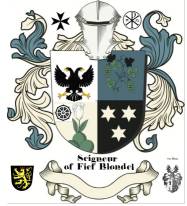
Blondel of the Nordic Channel Islands Guernsey Est. 1179 George Mentz
Bio -
George Mentz Noble Title -
George Mentz Ambassador - Order of the Genet
Knighthood Feudalherr - Fief Blondel von der Nordischen
Insel Guernsey Est. 1179 * New York Gazette ®
- Magazine of Wall Street - George
Mentz - George
Mentz - Aspen Commission - Ennerdale - Stoborough - ESG
Commission - Ethnic Lives Matter
- Chartered Financial Manager -
George Mentz
Economist -
George Mentz Ambassador -
George Mentz - George Mentz Celebrity -
George Mentz Speaker - George Mentz Audio Books - George Mentz Courses - George Mentz Celebrity Speaker Wealth
Management -
Counselor George Mentz Esq. - Seigneur Feif Blondel - Lord Baron
Longford Annaly Westmeath
www.BaronLongford.com * www.FiefBlondel.com |


Commissioner George Mentz - George
Mentz Law Professor - George
Mentz Economist
George Mentz News -
George Mentz Illuminati Historian -
George Mentz Net Worth
The Globe and Mail George Mentz
Get Certifications in Finance and Banking to Have Career Growth | AP News