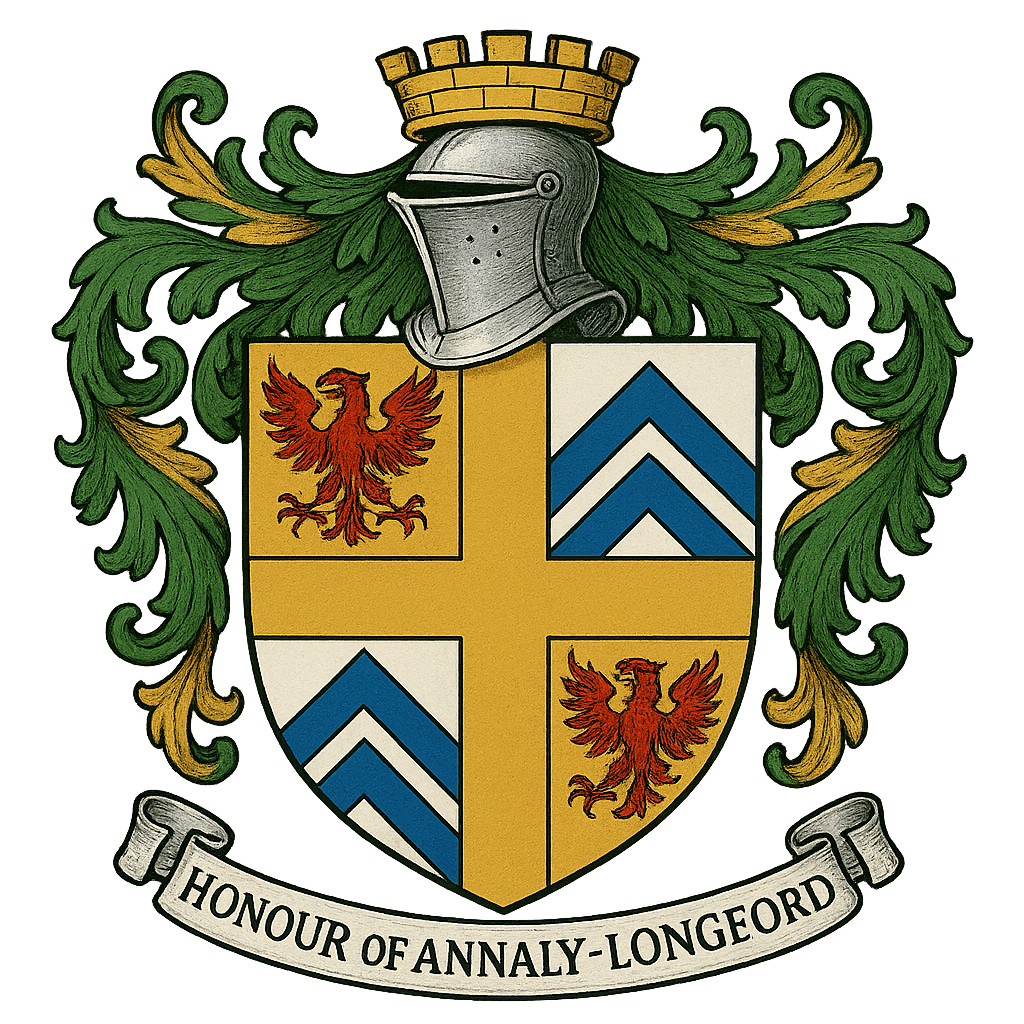
Honour of Annaly - Feudal Principality & Seignory Est. 1172




|

Law and Conveyance Law of IrelandIn the December 1918 election, the republican party Sinn Féin won a landslide victory in Ireland. On 21 January 1919 they formed a breakaway government (Dáil Éireann) and declared independence from Britain. The Free State came to an end with the coming into force of the new constitution on 29 December 1937, which with the Republic of Ireland Act 1948 officially became the Republic of Ireland. The '800 years' of English rule in Ireland nominally began in 1169, when an army of English barons (actually Cambro-Norman, being a mix of Welsh and Norman nobles) landed in Wexford and quickly captured the two Hiberno-Viking ports of Wexford and Waterford. The history of Ireland 800–1169 covers the period in the history of Ireland from the first Viking raids to the Norman invasion. ... Viking ports were established at Dublin, Wexford, Waterford, Cork and Limerick, which became the first large towns in Ireland. History of Ireland (1801–1923) Ireland was part of the United Kingdom of Great Britain and Ireland from 1801 to 1922. For almost all of this period, the island was governed by the UK Parliament in London through its Dublin Castle administration in Ireland. As a republic, the Irish Constitution precludes the state from conferring titles of nobility, and prevents citizens from accepting titles of nobility or honour – except with the prior approval of the government.[1] While some representatives of clans and familities had obtained "courtesy recognition" as Chiefs of the Name from the Chief Herald of Ireland, this practice was discontinued by 2003 – with the Attorney General noting that such recognitions were unconstitutional and without basis in law.[2][3][4] Certain titles are however sometimes used by some people in the Republic of Ireland,[citation needed] and titles are still used and awarded in Northern Ireland – which is part of the United Kingdom of Great Britain and Northern Ireland. The act abolishing feudal tenure in England was passed in 1660, and two years later an almost identical act was passed in Ireland. ... This act in effect abolished feudalism in Ireland, aside from some largely theoretical residues (see the full text of the Tenures Abolition Act 1662, courtesy of Derek Howard). Following a report by the Law Reform Commission, the system of feudal tenure as such, in so far as it had survived, was abolished by the Oireachtas in the Land and Conveyancing Law Reform Act (no. 27 of 2009); fee tail was also abolished [1]. However, estates and interests in land, including incorporeal hereditaments, continue. Formerly registered or proven feudal titles with a solid root of title, and the submerged feudal titles of surviving Irish or British peers are not affected, and continue to exist as personal rights, now held in gross. However, the obsolete or unregistered feudal titles, and those that lapsed into desuetude after 1662, when the Irish Parliament passed the Abolition of Tenures Act, no longer exist as incorporeal hereditaments, nor as personal rights, and cannot be revived. “LAND AND CONVEYANCING LAW REFORM ACT 2009” was intended to try and abololish feudal titles but nobody is sure if the law was written correctly. Section 9, subsection (4) states: “A fee simple remains freely alienable”. Fee Simple ownership does NOT mean that you own your property. It does mean that you have “an interest” in the property The Irish Law does not abolish any Customary Right or franchise jurisdictions. Scholars say that Baronies are franchise jurisdictions. Heritable Jurisdictions. The basic heritable jurisdiction was the barony, which was universal. Towns could be burghs of barony under a feudal superior. Though there was an appeal from the barony to the royal sheriff court, this was not true of baronies in the regalities. These units, some as small as a town, some like Argyll 500 square miles in extent, were autonomous jurisdictions with their own supreme courts. High treason alone justified royal intervention. heritable jurisdictions The Oxford Companion to British History © The Oxford Companion to British History 2002, originally published by Oxford University Press 2002. "heritable jurisdictions." The Oxford Companion to British History. .
Retrieved December 05, 2018 from Encyclopedia.com: https://www.encyclopedia.com/history/encyclopedias-almanacs-transcripts-and-maps/heritable-jurisdictions Reform and Modernisation of Land Law and Conveyancing Law ...
https://www.lawreform.ie/_fileupload/consultation%20papers/cp34.htm
[21] With the title “Modernising
Irish Land Law and Conveyancing Law”, the ...... which involves neither
feudal tenure nor the relationship of landlord and
tenant.
66 N. Ir. Legal Q. 243 (2015) - A Defence of Estates and Feudal Tenure https://heinonline.org/HOL/LandingPage?handle=hein.journals/nilq66&div=20&id= =
In the 13th Century in England the barons ceased to be peers, unless so created, but in Scotland, up to the year 1587,—in which year, various acts, drawn up by Lord Menmuir [see article BALCARREs, ante, p. 199] were passed for regulating the form and order of parliament and the vote of the barons,—the title of baron was common to all the landed proprietors or lairds, holding their lands directly of the Crown. The feudal system was introduced into England by the Norman Conquest. Its pressure on the common people was aggravated by the completeness of the subjection of the Saxon race. All the land was held by feudal tenure, and there was no allodium. The few Saxons who were permitted to retain their lands were brought under the feudal system; and the thanes were reduced to the condition of franklins, or simple freeholders. The Normans, who held most of the manors from the king, were called tenants-in-chief (in capite); and they were bound to knight service—that is, to maintain in the field, for forty days at a time, a certain force of their subtenants. This service extended to religious foundations and monasteries. Exclusive of these, 1400 tenants-in-chief and about 8000 mesne lords (holding fiefs not directly from the crown) are enumerated in Domesday Book. |
About Longford Feudal Prince House of Annaly Teffia Rarest of All Noble Grants in European History Statutory Declaration by Earl Westmeath Kingdoms of County Longford Pedigree of Longford Annaly What is the Honor of Annaly The Seigneur Irish Roots of George Mentz Chronology of Teffia Annaly Lords Paramount Ireland Market & Fair Chief of The Annaly One of a Kind Title Lord Governor of Annaly Prince of Annaly Tuath Principality Feudal Kingdom Irish Princes before English Dukes & Barons Fons Honorum Seats of the Kingdoms Clans of Longford Region History Chronology of Annaly Longford Oldest Gaelic Kingdom Hereditaments Captainship of Ireland Princes of Longford Holy Sites & Gods News Parliament 850 Years Leadership Titles of Annaly Irish Free State 1172-1916 Feudal Princes 1556 Habsburg Grant and Princely Title Rathline and Cashel Kingdom The Last Irish Kingdom Landesherrschaft King Edward VI - Grant of Annaly Granard Spritual Rights of Honour of Annaly Principality of Cairbre-Gabhra House of Annaly Teffia 1400 Years Old Count of the Palatine of Meath Irish Property Law Manors Castles and Church Lands A Barony Explained Moiety of Barony of Delvin Nugents of Annaly Ireland Spiritual & Temporal Islands of The Honour of Annaly Longford Blood Dynastic Burke's Debrett's Peerage Recognitions Water Rights Annaly Property Law Writs to Parliament Irish Nobility Law Moiety of Ardagh Dual Grant from King Philip of Spain Rights of Lords & Barons Princes of Annaly Pedigree Abbeys of Longford Styles and Dignities Ireland Feudal Titles Versus France & Germany Austria Sovereign Title Succession Mediatized Prince of Ireland Grants to Delvin Lord of St. Brigit's Longford Abbey Est. 1578 Feudal Barons Water & Fishing Rights Clan Brehon Tribal Law Comparison Ancient Castles and Ruins Abbey Lara Honorifics and Designations Kingdom of Meath Feudal Westmeath Seneschal of Meath Lord of the Pale Irish Gods The Feudal System Baron Delvin Kings of Hy Niall Colmanians Irish Kingdoms Order of St. Columba Chief Captain Kings Forces Commissioners of the Peace Tenures Abolition Act 1662 - Rights to Sit in Parliament Contact Law of Ireland List of Townlands of Longford Annaly English Pale Court Barons Lordships of Granard Irish Feudal Law Datuk Seri Baliwick of Ennerdale Moneylagen Lord Baron Longford Baron de Delvyn Longford Map Lord Baron of Delvin Baron of Temple-Michael Baron of Annaly Kingdom Annaly Lord Conmaicne Baron Annaly Order of Saint Patrick Baron Lerha Granard Baron AbbeyLara Baronies of Longford Princes of Conmhaícne Angaile or Muintir Angaile Baron Lisnanagh or Lissaghanedan Baron Moyashel Baron Rathline Baron Inchcleraun HOLY ISLAND Quaker Island Longoford CO Abbey of All Saints Kingdom of Uí Maine Baron Dungannon Baron Monilagan - Babington Lord Liserdawle Castle Baron Columbkille Kingdom of Breifne or Breny Baron Kilthorne Baron Granarde Count of Killasonna Baron Skryne Baron Cairbre-Gabhra AbbeyShrule Events Castle Site Map Disclaimer Irish Property Rights Indigeneous Clans Dictionary Maps Honorable Colonel Mentz Valuation of Principality & Barony of Annaly Longford Irish Noble Titles of Annaly Longford“The Princely House of Annaly–Teffia is a territorial and dynastic house of approximately 1,500 years’ antiquity, originating in the Gaelic kingship of Teffia and preserved through the continuous identity, property law, international law, and inheritance of its lands, irrespective of changes in political sovereignty.”
Feudal Baron of Longford Annaly - Baron Longford Delvin Lord Baron &
Freiherr of Longford Annaly Feudal Barony Principality Count Kingdom of Meath - Feudal Lord of the Fief
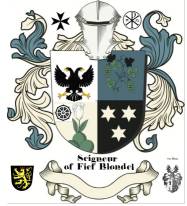
Blondel of the Nordic Channel Islands Guernsey Est. 1179 George Mentz
Bio -
George Mentz Noble Title -
George Mentz Ambassador - Order of the Genet
Knighthood Feudalherr - Fief Blondel von der Nordischen
Insel Guernsey Est. 1179 * New York Gazette ®
- Magazine of Wall Street - George
Mentz - George
Mentz - Aspen Commission - Ennerdale - Stoborough - ESG
Commission - Ethnic Lives Matter
- Chartered Financial Manager -
George Mentz
Economist -
George Mentz Ambassador -
George Mentz - George Mentz Celebrity -
George Mentz Speaker - George Mentz Audio Books - George Mentz Courses - George Mentz Celebrity Speaker Wealth
Management -
Counselor George Mentz Esq. - Seigneur Feif Blondel - Lord Baron
Longford Annaly Westmeath
www.BaronLongford.com * www.FiefBlondel.com |


Commissioner George Mentz - George
Mentz Law Professor - George
Mentz Economist
George Mentz News -
George Mentz Illuminati Historian -
George Mentz Net Worth
The Globe and Mail George Mentz
Get Certifications in Finance and Banking to Have Career Growth | AP News